
KOREFIB® Rebar Composite reinforcing bar for concrete
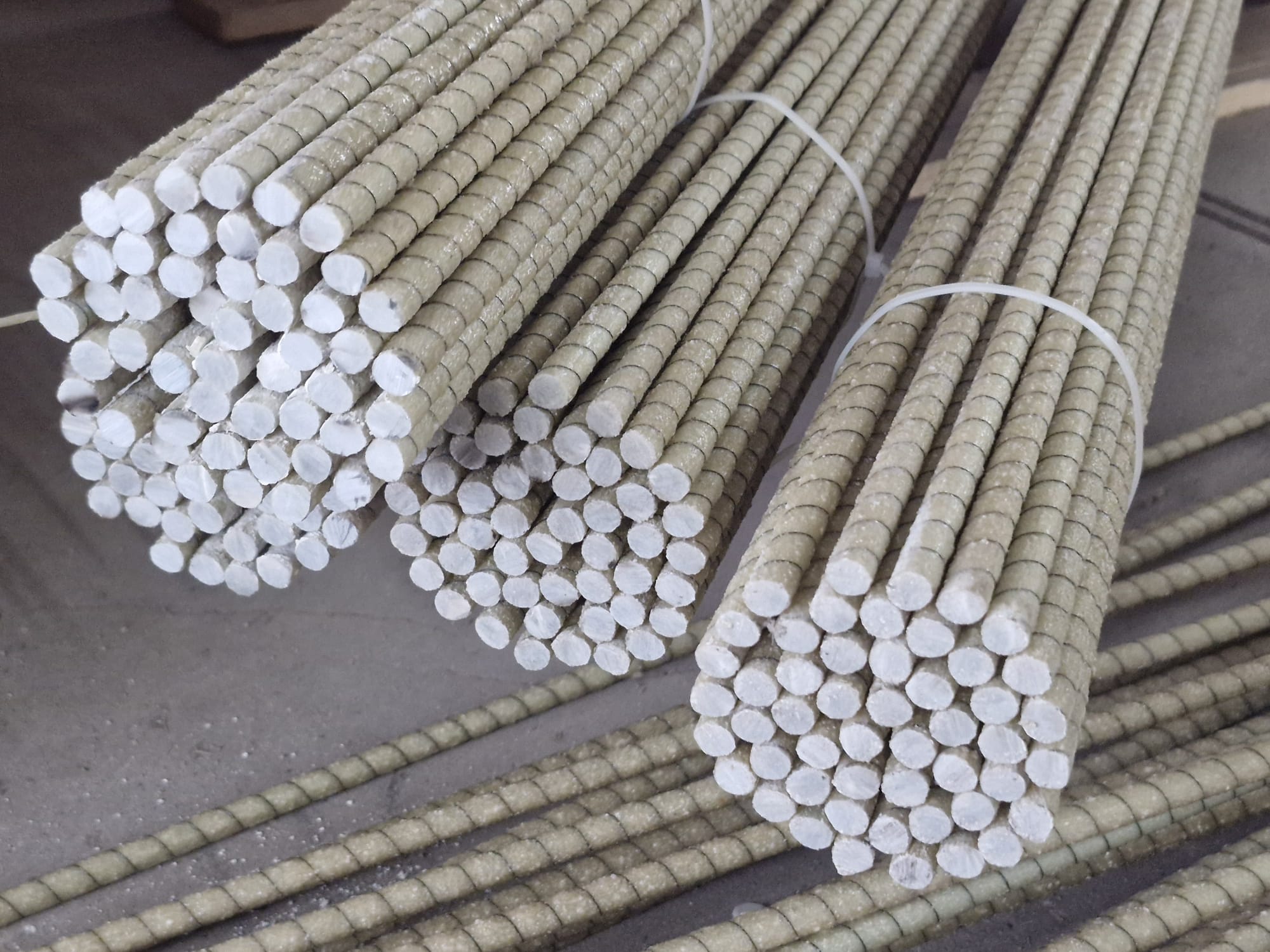
Composite reinforcing bars Ø 5–10 mm
KOREFIB® Rebar are composite reinforcing bars made of glass fibers with a sand-coated surface for a better bond with concrete. They are designed as a lightweight, non-corroding alternative to steel reinforcement in applications where low weight, corrosion resistance, easy handling and long service life matter. They are suitable for foundation slabs, concrete elements, precast components, spacers, reinforcement for damp environments and structures where non-conductivity and non-magnetic properties are an advantage.
Documents to download
Certificate KOREFIB® Rebar / PDF Technical Building Certificate (STO) Diameters 5, 6, 8, 10 mm / PDF Technical data sheet Ø 5 mm KOREFIB® Rebar / PDF Technical data sheet Ø 6 mm KOREFIB® Rebar / PDF Technical data sheet Ø 8 mm KOREFIB® Rebar / PDF Technical data sheet Ø 10 mm KOREFIB® Rebar / PDF

_en.png?6a7597dd)
_en.png?6a759798)
_en.png?6a75986b)
KOREFIB® Rebar
Composite reinforcing bars made of glass fibers bound with a heat-cured epoxy resin. The surface is coated with a layer of silica sand that improves the bond with concrete. A lightweight, non-corroding alternative to steel reinforcement for foundation slabs, precast production and aggressive environments.
We supply diameters of 5, 6, 8 and 10 mm, in lengths of 1, 2, 3 and 6 m or in coils of 50 and 100 m. The bars are intended mainly for non-structural reinforcement of concrete structures, walls, slabs and floors to limit shrinkage.
For common floors, slabs and precast production, the most frequent choice is a 6 mm diameter. For light distribution and supplementary applications, 5 mm is sufficient; for structures with a higher demand on tensile reinforcement, choose 8 or 10 mm. The 50 and 100 m coils are suitable where you need to cut the reinforcement to size directly on site.
Technical parameters by diameter
| Property | Ø 5 mm | Ø 6 mm | Ø 8 mm | Ø 10 mm |
|---|---|---|---|---|
| Tensile strength fu,cMPa — ISO 10406-1 | 1,459 | 1,296 | 1,359 | 1,298 |
| Modulus of elasticity EmGPa — ISO 10406-1 | 46.9 | 47.4 | 46.5 | 44.1 |
| Tensile stiffness EakN — ISO 10406-1 | 866 | 1,383 | 2,184 | 3,251 |
| Ultimate strain εu% — ISO 10406-1 | 3.33 | 2.98 | 3.00 | 3.07 |
| Bond to concreteN/mm² — ISO 10406-1 | 13.7 | 12.2 | 10.7 | 9.2 |
| Shear strengthN/mm² — ISO 10406-1 | 236 | 255 | 258 | 197 |
| Fiber mass content% — EN ISO 1172 | 80.9 | 82.9 | 83.1 | 80.2 |
Values are based on technical data sheets TL-KOREFIB-REBAR-5/6/8/10-2025-01. The product was verified by tests carried out by the accredited testing laboratory TZÚS Praha, s.p., Brno test house, according to ISO 10406-1 and EN ISO 1172. The values apply to the tested product and the stated test conditions. Use in a specific structure must be verified according to the required function of the reinforcement, the structural design, the loading and the conditions of use.
Available lengths and coils
How to work with KOREFIB® Rebar
- Store the bars so that the sand-coated surface is not mechanically damaged.
- When cutting, use a suitable disc and protection for the eyes, hands and airways.
- Maintain the reinforcement cover and position according to the design, and use suitable spacers.
- Fix the reinforcement with plastic ties or suitable binding.
- The bars are not bent on site — shaped elements must be arranged in advance with the manufacturer.
- Laps, anchorage and connections should follow the designer’s design, not a diameter comparison with steel.
GFRP has a different modulus of elasticity than steel, so it is necessary to assess not only strength but also deformations, crack width and anchorage in the specific structure.
Where KOREFIB® Rebar is used
Unlike area reinforcement, the bars are placed specifically where tension needs to be carried. They make the most sense in operations where steel reinforcement would corrode even with adequate cover, and where the conductivity or magnetism of steel is a problem.
They are also used as supplementary and distribution reinforcement in foundation slabs and floors, in precast production thanks to the lower weight of the elements, and as spacers or reinforcement for structures in contact with soil and de-icing salts.
Advantages of KOREFIB® Rebar
- Does not corrode in damp, alkaline, saline or chemically loaded environments
- The sand-coated surface provides a bond to concrete of up to 13.7 N/mm²
- High tensile strength — up to 1,459 MPa depending on diameter
- Up to 7× lighter than steel, easy transport and manual handling
- Electrically non-conductive and non-magnetic
- The 50 and 100 m coils allow cutting to size without waste
Product rating
Be the first who will post an article to this item!