
KOREFIB® MacroFibers G40 Composite fibres for concrete
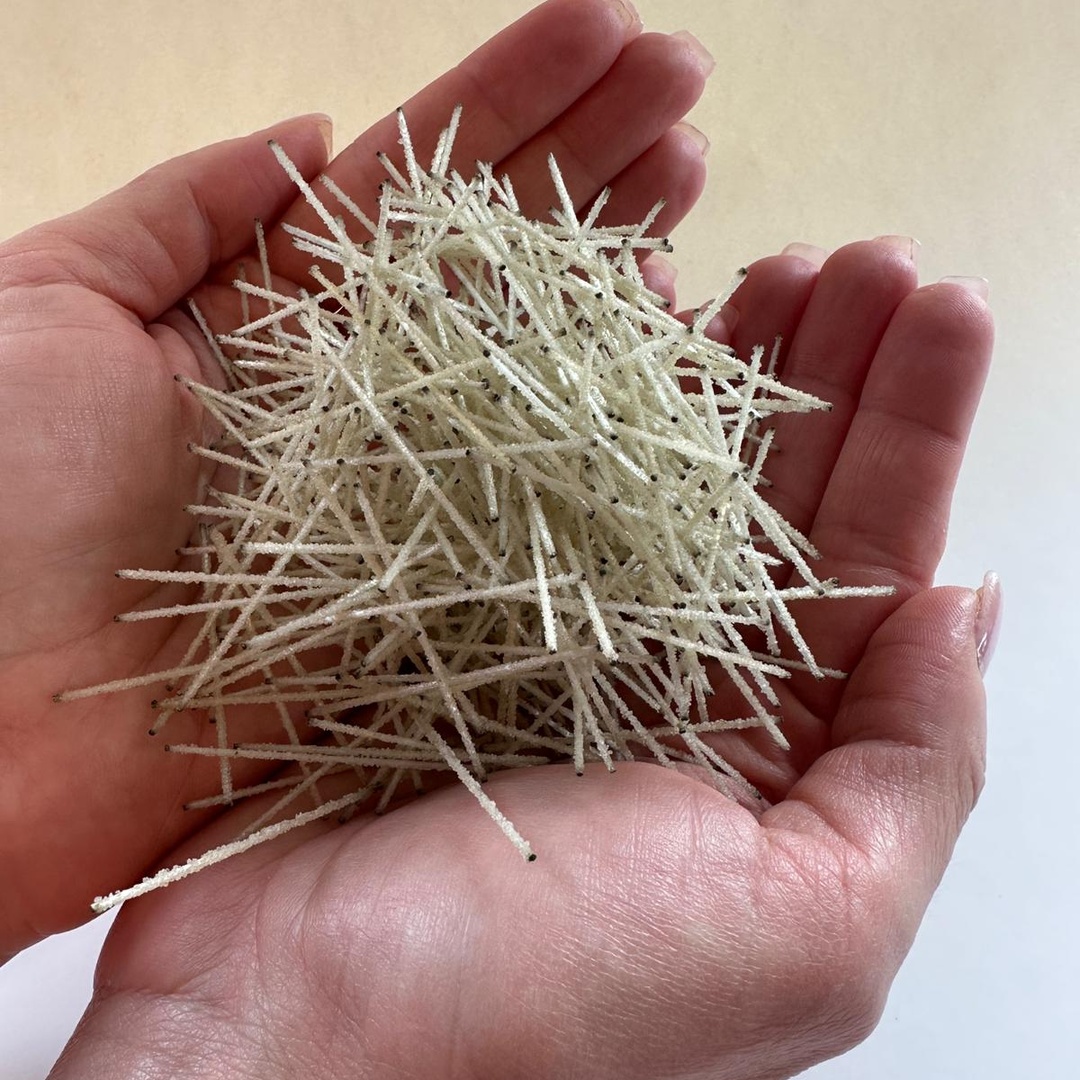
Composite macro fibres for concrete
KOREFIB® G40 are composite macro fibres made of glass fibres, designed to reinforce concrete, limit the formation of shrinkage cracks and improve the behaviour of concrete after a crack forms. They are used as dispersed reinforcement in floors, foundation slabs, precast elements, concrete components and structures where corrosion resistance, simple dosing and even dispersion of the reinforcement throughout the whole concrete mix are required.




KOREFIB® MacroFibers G40
Composite macro fibres 40 mm long, based on ECR glass fibres and an epoxy polymer matrix. A dispersed reinforcement for concrete, screeds, floor slabs and precast elements that, once mixed in, creates a three-dimensional reinforcement throughout the entire volume of the concrete — corrosion-free and without placing area reinforcement.
The fibres are dosed directly into the concrete mix at 1–7 kg/m³ depending on the type of structure and the required function. They serve to limit shrinkage cracks, increase toughness and improve the residual strength after a crack forms.
For common screeds, floor slabs on grade and screeds over underfloor heating, the most common choice is a dosage of 3–4 kg/m³. For industrial floors with higher service loading and forklift traffic, the dosage increases to 4–7 kg/m³. Before series production we recommend verifying workability with a trial batch.
Technical parameters
| Parameter | KOREFIB® MacroFibers G40 |
|---|---|
| Fibre length standard G40 length | 40 ± 2 mm |
| Fibre diameter per test report | 0.92 mm |
| Number of fibres manufacturer declaration | approx. 20,000 pcs/kg |
| Tensile strength value from label / technical documents | 740 MPa |
| Modulus of elasticity per tests | 26.9 GPa |
| Concrete consistency EN 14845-1 | C2 at 7 kg/m³ |
| Residual strength EN 14845-2 at 7 kg/m³ | 1.6 MPa at CMOD 3.5 mm |
| Material fibre composition | ECR glass + epoxy matrix |
The values given are based on test reports and technical documents from the manufacturer. They are indicative values for dispersed reinforcement. They are not design values, nor an automatic replacement for load-bearing reinforcement — for structurally significant structures the use must be verified by calculation or by a designer’s assessment.
Indicative dosage
| Dosage | Typical use | Purpose |
|---|---|---|
| 1–3 kg/m³ | Concrete, screeds, precast elements | Increased toughness, reduced shrinkage cracking and improved overall behaviour of the mix. |
| 3–4 kg/m³ | Floor slabs on grade, screeds over underfloor heating, garages, precast elements | Better crack control, improved distribution of tensile stresses and increased resistance of normally loaded structures. |
| 4–7 kg/m³ | Floor slabs, industrial floors with high loading, warehouses, operations with forklift traffic | Higher residual strength after cracking and improved behaviour of the concrete under service loading. |
The dosage given is indicative. The exact amount must be determined according to the specific structure, the concrete mix design, the loading and the required function of the fibres.
Packaging and consumption
Processing in the concrete mix
- Add the fibres gradually, never the entire amount at once in one place.
- Ensure a sufficient mixing time for even dispersion of the fibres throughout the volume.
- Check the consistency and workability of the mix after adding the fibres.
- For higher dosages, adjust the concrete mix design or the plasticizer dosage as needed.
- Before series production, carry out a trial batch and verify the resulting properties.
Even dispersion of the fibres is key to their correct function. Insufficient mixing can lead to fibre balling and uneven reinforcement.
Typical applications
Advantages of KOREFIB® MacroFibers G40
- Three-dimensional reinforcement throughout the whole volume of concrete, not just in one plane
- Dosed directly into the mix without placing and tying meshes
- Suitable for outdoor areas — do not corrode in damp or chemically loaded environments
- A high number of fibres per dose — approx. 20,000 pcs/kg
- Limit the formation and development of both shrinkage and service cracks
- Increase the toughness of the concrete and improve the behaviour of the element after failure
Product rating
Be the first who will post an article to this item!